





























































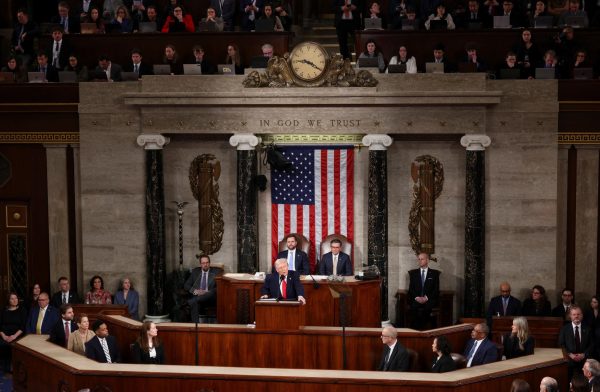
WASHINGTON — President Donald Trump delivered the first official State of the Union address of his second term Tuesday night, using the record-setting speech to declare what he called an economic “turnaround for the ages” and to frame his return to office as the start of a new American “golden age.” At 1 hour and 48 minutes, the address marked the longest State of the Union speech in modern history.
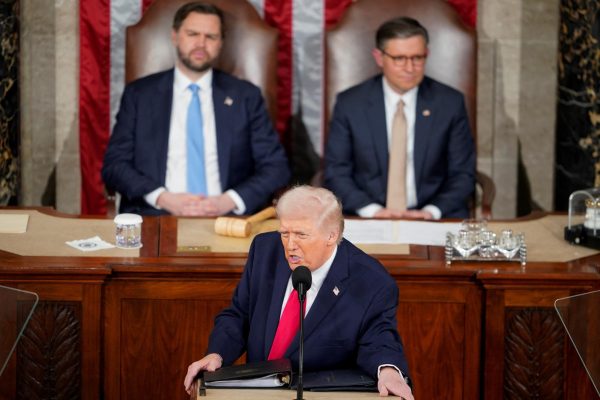
Speaking before a joint session of Congress, Trump opened his address by claiming the nation was “winning again,” pointing to falling inflation, lower gas prices, stock market gains, and sweeping tax reforms as evidence that his administration had reversed what he described as the economic failures of former President Joe Biden. At the center of his economic message was legislation he dubbed the “One Big Beautiful Bill Act,” which he said would expand the child tax credit and eliminate federal taxes on tips and overtime pay. It was at this time that Trump would spotlight one of his many special guests, Megan Hemhauser, a mother from Pennsylvania who homeschools her children and waits tables at night while her husband works overtime operating heavy equipment. According to President Trump, Megan’s family would save more than $5,000 this year under the new tax structure. He stated that core inflation had fallen to 1.7% in late 2025, which is accurate under certain short-term, annualized measures of core CPI, but broader calculations place it closer to 2.2%. Overall inflation remains above the Federal Reserve’s 2% target. He also said gasoline prices had dropped below $2.30 per gallon in most states. In reality, the national average price of regular gasoline was about $2.95 per gallon, and no state’s average was below $2.37 at the time, though a few individual stations may have sold gas for less than $2.00.
Trade policy also featured prominently in President Trump’s address. Trump credited his aggressive tariff strategy with fueling market growth and generating hundreds of billions in revenue, even after the Supreme Court struck down his use of emergency authority to impose sweeping “reciprocal” tariffs. The tariffs exceed the powers granted to the president by Congress under a 1977 law authorizing the regulation of commerce during national emergencies created by foreign threats. He shook hands with Chief Justice John Roberts and Justices Elena Kagan and Amy Coney Barrett, but criticized the ruling as “unfortunate” and signaled plans to pursue alternative legal avenues. The president argued that future tariff revenue could help reduce Americans’ federal income taxes, casting the policy as both a shield for the domestic industry and a potential source of fiscal relief. However, while he framed tariffs as a strategy to strengthen American manufacturing and rebalance trade, public opinion surveys show that 64% dissatisfaction among voters are dissatisfied, believing the policy has contributed to higher consumer costs.
Throughout the speech, Trump repeatedly blamed Democrats for what he called the “affordability crisis,” dismissing their criticism as a “dirty, rotten lie” and insisting prices were now “plummeting.” Democratic lawmakers remained seated for much of the address, prompting sharp rebukes from the president. Immigration was another central theme, with Trump declaring the border “secure” and condemning prior “open-border policies.”
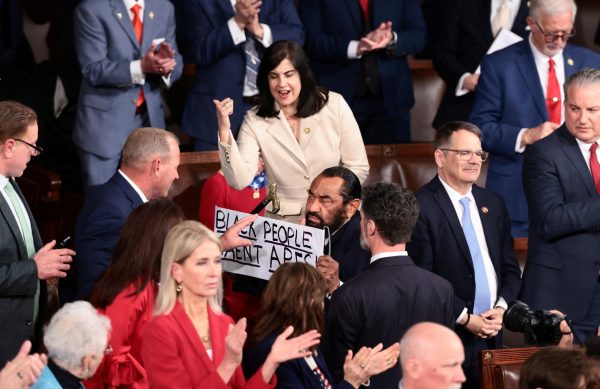
His remarks sparked immediate backlash from Democrats, as Ilhan Omar (D-MN) disrupted Trump’s State of the Union address, shouting that he “killed Americans” after he criticized Minnesota’s Somali community and sought to needle Democrats over immigration policy. During his address to Congress, Trump chastised members of the House for not “standing up” when he declared that “the first duty of the American government is to protect American citizens, not illegal aliens,” adding, “Isn’t that a shame? You should be ashamed of yourself for not standing up.” Meanwhile, Al Green (D-Texas) stood behind the president holding a sign that read, “Black people aren’t apes,” before being escorted from the chamber minutes later following what appeared to be a heated exchange with several Republicans as he exited.
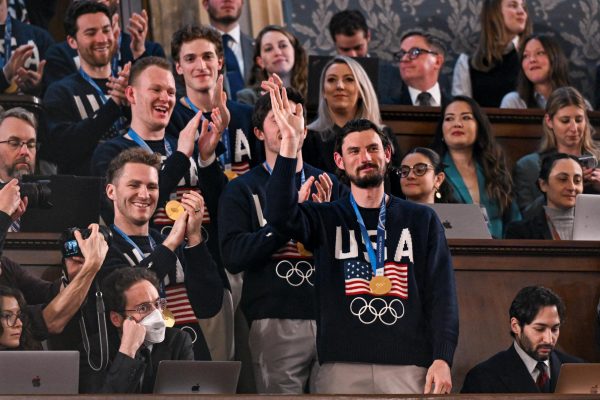
In one of the evening’s most celebratory moments, Trump recognized members of the U.S. men’s Olympic hockey team seated in the gallery following their gold medal victory. Calling the team a symbol of national resurgence, he drew chants of “USA” from Republican lawmakers. He also announced plans to honor goaltender Connor Hellebuyck with the Presidential Medal of Freedom, and praised players such as Jack Hughes as examples of American excellence.
Beyond economics and immigration, Trump outlined additional policy priorities, including making permanent a ban on large investment firms purchasing single-family homes, codifying a “most favored nation” prescription drug pricing policy, mandating healthcare price transparency, prohibiting members of Congress from insider stock trading, and negotiating energy arrangements to prevent electricity rate hikes tied to AI data centers. He also honored military heroes and first responders, awarding the Medal of Honor, Purple Hearts, and the Legion of Merit, and referenced the January military operation that led to the capture of Venezuelan leader Nicolás Maduro, praising the American service members involved.
With Republicans preparing to defend their congressional majorities in the upcoming midterm elections and the nation approaching its 250th anniversary of independence, Trump tied his presidency to the country’s founding ideals. “Our nation is back bigger, better, richer, and stronger than ever before,” he said in closing. “The golden age of America is upon us.”

Susan Weber • Feb 27, 2026 at 10:43 am
Thanks for the summary. Well done.