






































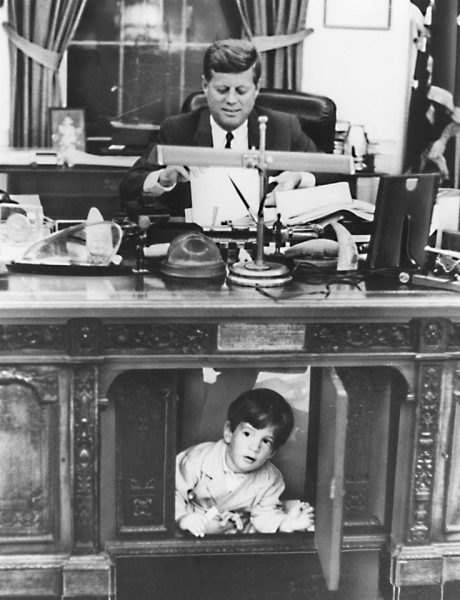
There is a photograph that America never learned how to forget. A three-year-old boy in a tiny blue coat lifts his hand to salute his father’s coffin, John F. Kennedy Jr. He was a child too young to comprehend loss, yet drafted into national mythology in a single shutter click. For a country that rejects monarchy while secretly craving it, that picture became the American coronation of a boy who never asked for a crown. He became the heir to a dream that died before it had time to grow old.
It makes perfect sense that Ryan Murphy resurrected that dream in 2026 with Love Story: John F. Kennedy Jr. & Carolyn Bessette on FX. Of course, America tuned in. Of course, people binged it like scripture. Murphy didn’t just recreate a marriage; he reopened a wound, and in Paul Anthony Kelly’s calm intensity and Sarah Pidgeon’s steel-and-silk performance, Americans once again tried to puzzle out the couple that the world never allowed to simply live.
But let’s be honest: the obsession has nothing to do with Murphy. It has everything to do with John.
Because for all the glamour, all the magazine covers, all the breathless paparazzi photos of him jogging in the ’90s, John F. Kennedy Jr. always represented something far more powerful than celebrity. He represented the idea that charisma, intellect, and idealism could coexist in one man without collapsing under the weight.
And possibility is addictive.
To understand why the weight on John F. Kennedy Jr.’s shoulders was so crushing, you have to go back to the beginning, to the creation of the American political dynasty that never got to finish its story.

His father, President John F. Kennedy Sr., entered the White House in 1961 like a beam of light breaking through an old window. Young, handsome, witty, televised at the dawn of the media age — he symbolized a modern America still trying to believe in its own promise. He spoke about civil rights when doing so was politically inconvenient. He stared down the Cuban Missile Crisis with a calm that belied how close we came to annihilation. He talked about sending a man to the moon, not because it was easy, but because it was hard. He made ambition patriotic.
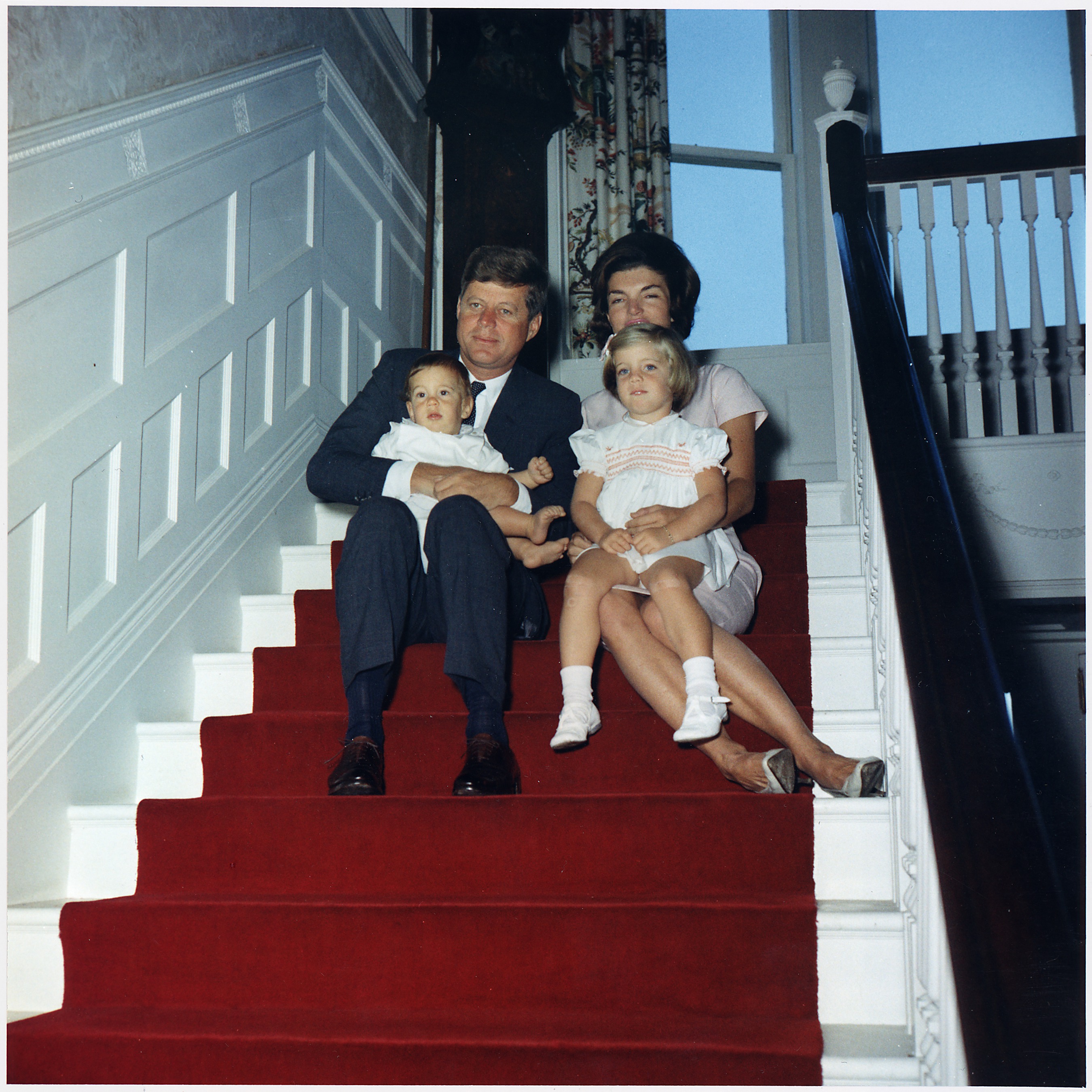
And then, in Dallas, that dream was shattered in broad daylight.
The assassination of President John F. Kennedy Sr. in 1963 didn’t just kill a leader; it created a vacuum so vast that the country immediately looked to the next Kennedy in line, Robert F. Kennedy, to fill it.
RFK didn’t start his political career as his brother’s mirror. He started as his guardian– tough, skeptical, fiercely loyal. But when he stepped into the arena for himself, something remarkable happened: he transformed. He became the conscience of the Democratic Party. He walked the streets of Bedford-Stuyvesant. He traveled to Appalachia. He spoke to farm workers in California. He talked about poverty as a moral crisis and racial injustice as a national wound that could no longer be ignored.
In 1968, RFK’s presidential campaign felt like the country’s second chance — not just to continue JFK’s unfinished work, but to redeem the heartbreak of the decade. People saw in him a leader who understood loss, who had evolved, who believed America could be healed rather than managed.
And then Los Angeles happened.
Two brothers gone. Two dreams cut down. Two shocks so traumatic that an entire generation still remembers where they were.
That is the inheritance John F. Kennedy Jr. walked into.
Before he could spell his own name, America had already written his destiny for him. He wasn’t just a child anymore; he was the last living symbol of an idea that a Kennedy would someday return to the White House and restore the optimism that died in Dallas and Los Angeles.
His father had been the nation’s future.
His uncle had been the nation’s redemption.
So John Jr. became, by default, the nation’s what comes next?
By the time he reached adulthood, he was the most famous private citizen in America. When he passed the bar exam on his third try, the headlines weren’t about his accomplishments; they were about whether a Kennedy should be a prosecutor or a senator. When he launched George magazine, people treated it like a political audition tape.

Everywhere he went, there were whispers:
“When is he running?”
“What office will he take?”
“He owes the country at least one campaign.”
The burden wasn’t subtle. It wasn’t optional. And it wasn’t fair.
America didn’t allow John Jr. to simply be John Jr.
America needed him to be the third act in a story that ended too suddenly.
The son who would finish his father’s work.
The nephew who would avenge his uncle’s loss.
The man who would bring Camelot out of nostalgia and back into reality.
That’s the weight he carried. That’s the weight America put on him.
While I don’t pretend to fully understand what that must have been like, I can only speak for myself when I say it had to have been awful because I can sort of relate.
My mom left my father when I was a year old. While we have a great relationship now, the truth is I went the first 20 years of my life without a mother in the house, and that absence shaped me in ways I’m only now beginning to understand. My family felt sorry for me the way a nation felt sorry for John Jr. after his father passed away. It was not out of pity, but out of a kind of protective grief. They saw a child who had been dealt a wound too early, a void that others felt compelled to fill with expectations, hopes, and predictions about who I’d become. I understand that weight. I grew up with expectations hanging over me like a stage light- hot, bright, and unblinking. My aunts told my great-grandmother that I’d “make something” of myself, that five-year-old Ryder would carry the family name the way John carried a national hope. And like him, I learned early that fascination doesn’t mean people see you. It means they see what they want you to symbolize.
America has never stopped projecting onto him. Because America has never stopped asking the questions that history refused to answer.
The great American fascination with John F. Kennedy Jr. is rooted in the unresolved chapters of his family’s story, the “what ifs” that loom as large as the man himself. We wonder, still, what might have happened if President John F. Kennedy Sr. had lived through the rest of the 1960s. Would Vietnam have unfolded the same way, or would a president who distrusted military escalation have slowed it or even avoided it entirely? Would the Civil Rights Movement have accelerated under a leader who understood television better than any president before him? Could he have changed the tone of 1964 to 1968, altering the nation’s temperature before it reached a boil? Would the Democratic Party have splintered so violently in 1968, or would Chicago’s streets have erupted with the same rage? And had Dr. King lived to see a second Kennedy administration, would he have found in JFK a different kind of ally or at least a different kind of government to pressure?
And then we turn to Robert F. Kennedy Sr., whose assassination only deepened the nation’s sense of stolen potential. What if RFK had survived Los Angeles and gone on to win the presidency? Would he have been the bridge across the chaos between races, between classes, between generations? Would he have become the moral lodestar of a country fraying at its seams? His absence is one of the great unanswered questions of American political life, and the burden of those questions eventually settled on the shoulders of his nephew, John Jr.
What if John F. Kennedy Jr. had lived long enough to evolve George magazine into the political–pop culture hybrid America desperately needs today? Imagine George in 2026: Beyoncé on a “Power of Influence” cover, Zendaya speaking about youth activism, Taylor Swift analyzing digital mobilization, Robert Downey Jr. discussing the ethics of AI, a blistering roundtable on the state of American democracy in the algorithm age. John understood something few in the media ever have: that politics is downstream not of policy, but of culture.

And then, of course, comes the unavoidable question: how would George have covered Donald J. Trump? Would John have confronted him with charm or with steel? Would he have contextualized the Trump phenomenon the way only a Kennedy could understand both the spectacle and the stakes? What would he have said about his cousin’s role in the cabinet, or the political ambitions brewing among his own nephew? These are the questions that keep the Kennedy myth alive, suspended forever between what was and what might have been.
These aren’t fantasies. They are the vacuum that history created when the Piper Saratoga spiraled into the Atlantic in July of 1999. The details of the crash, late departure, coastal haze, and spatial disorientation tell the technical story. But the emotional story is the one America never recovered from: a life cut short before it could step into its final act.
I see some of myself in him, not the fame, not the dynasty, but the tension. The tug-of-war between public expectation and private vocation. The awareness that your name sometimes walks into the room before you do. And maybe that’s why this story still matters — because John wasn’t just a Kennedy. He was a mirror. A symbol of every dream interrupted too soon, every ambition half-formed, every destiny left suspended mid-sentence.
Obsession is how America grieves. And America has been grieving him for 27 years.
We obsess because he never had the chance to disappoint us.
We obsess because potential is immortal.
We obsess because John F. Kennedy Jr offered something rare in American public life — sincerity without cynicism, charm without calculation, idealism without naiveté.
Would he have run for senator? For governor? For president? Would he have been the antidote to our modern political cynicism? Would he have stood at the intersection of courage and culture in a way nobody else could?
We’ll never know. And that’s the point.

John F. Kennedy Jr. lives on not in what he did, but in what he might have done. His life, a prism of tragedy, beauty, and possibility, continues to captivate because it mirrors our own complicated longing for a better, wiser, more hopeful America.
We watch.
We wonder.
We imagine.
And in that imagining, he remains alive forever America’s child, forever frozen at the intersection of promise and myth, forever the question at the center of a nation still trying to answer:
What might have been?